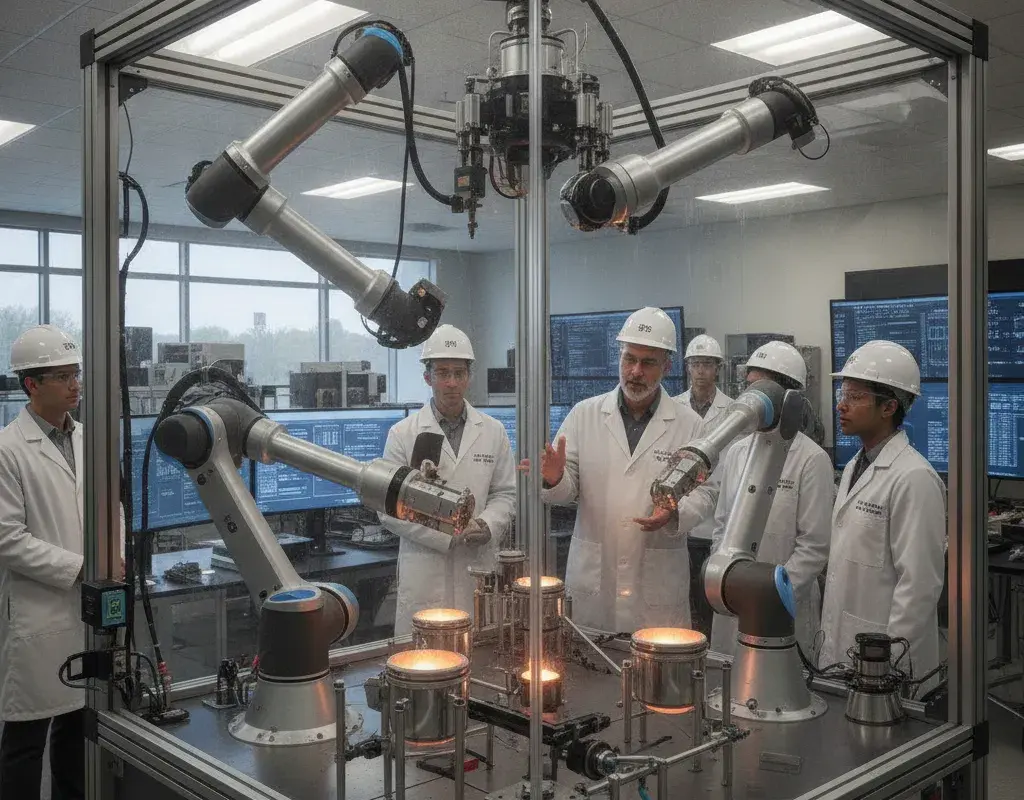
Texas A&M University is set to transform the way the world discovers new metals thanks to a two million dollar gift from the WoodNext Foundation. This funding will establish the Aggie AI Foundry, a pioneering facility designed to replace months of tedious manual labor with high speed automation. By combining artificial intelligence with precision robotics, researchers aim to slash the time it takes to develop new alloys from several months down to a single week or less.
The project is led by professors Ibrahim Karaman and Raymundo Arroyave, who envision a workspace where AI acts as the brain and robots serve as the hands. While computers can suggest potential combinations of elements, creating an alloy requires physical melting and testing at extreme temperatures reaching 3,000 degrees Celsius. In this new lab, robotic arms will act like an assembly line, mixing and processing elements from a massive digital library to find materials that could revolutionize aerospace, defense, and healthcare technology.
For the faculty involved, this shift isn’t just about speed but about freeing human intellect. Professor Arroyave compared current graduate students to line cooks who spend too much time chopping vegetables instead of acting as chefs. By automating the repetitive tasks of synthesis and sampling, students and scientists can move away from the grueling physical labor of metallurgy and focus on high level analysis and creative problem solving.
The sheer scale of possibility makes this leap into AI necessary. With dozens of elements available on the periodic table, there are roughly a trillion different ways to mix metals—a number far beyond human capacity to navigate manually. Through this partnership with the foundation established by Roku founder Anthony Wood and his wife Susan, Texas A&M is building the first academic lab capable of handling such complex thermal processes autonomously, opening the door to discoveries that were previously mathematically invisible.